

What Dental Implants Really Cost in Katy, TX and Why
At TUTH Dental, we believe everyone deserves a confident, beautiful smile—and clear aligners can help you achieve just that. Our modern, discreet alternative to traditional braces is designed to straighten your teeth comfortably and without interrupting your lifestyle. Serving the Katy, TX community, our skilled dental team is here to guide you through every step of your smile transformation with personalized care and cutting-edge technology.

What Dental Implants Really Cost in Katy, TX
When you're considering dental implants, understanding the investment is part of understanding the procedure itself. What goes into a well-done result, how treatment is planned, and why no two cases are alike are all questions worth answering before you ever sit in a chair.
Around Katy, a single dental implant typically ranges from $3,000 to $5,000, reflecting the post, abutment, crown, and the clinical expertise behind each stage. A full-arch restoration generally begins around $20,000 and up, depending on the complexity of your case. Every case is custom, and the treatment plan reflects the precision that comes with our level of care.
Implants are among the most personalized procedures in dentistry. Your plan is shaped by your anatomy, your goals, and the result you want to achieve. This guide, put together by Dr. Taline and the team at TÜTH Dental, is designed to give you the full picture so that when you come in for a consultation, you're focused on the outcome. If you'd like to speak with us directly, we're available at (281) 717-4928 or you can schedule a consultation at our Katy office.
What This Guide Covers
- What a single implant and a full-arch restoration actually involve, from the first imaging appointment through final crown placement
- The components and clinical stages that make an implant a complete, permanent tooth replacement
- The clinical variables that shape each treatment plan and why no two cases are identical
- How implants compare to bridges, dentures, and All-on-4 over the long term
- What the investment in a permanent restoration typically involves and how to plan for it
- How to evaluate a provider's clinical depth before committing to treatment
- What to expect from a thorough consultation and how to prepare for one
What Makes Up a Dental Implant: The Craftsmanship Behind the Result
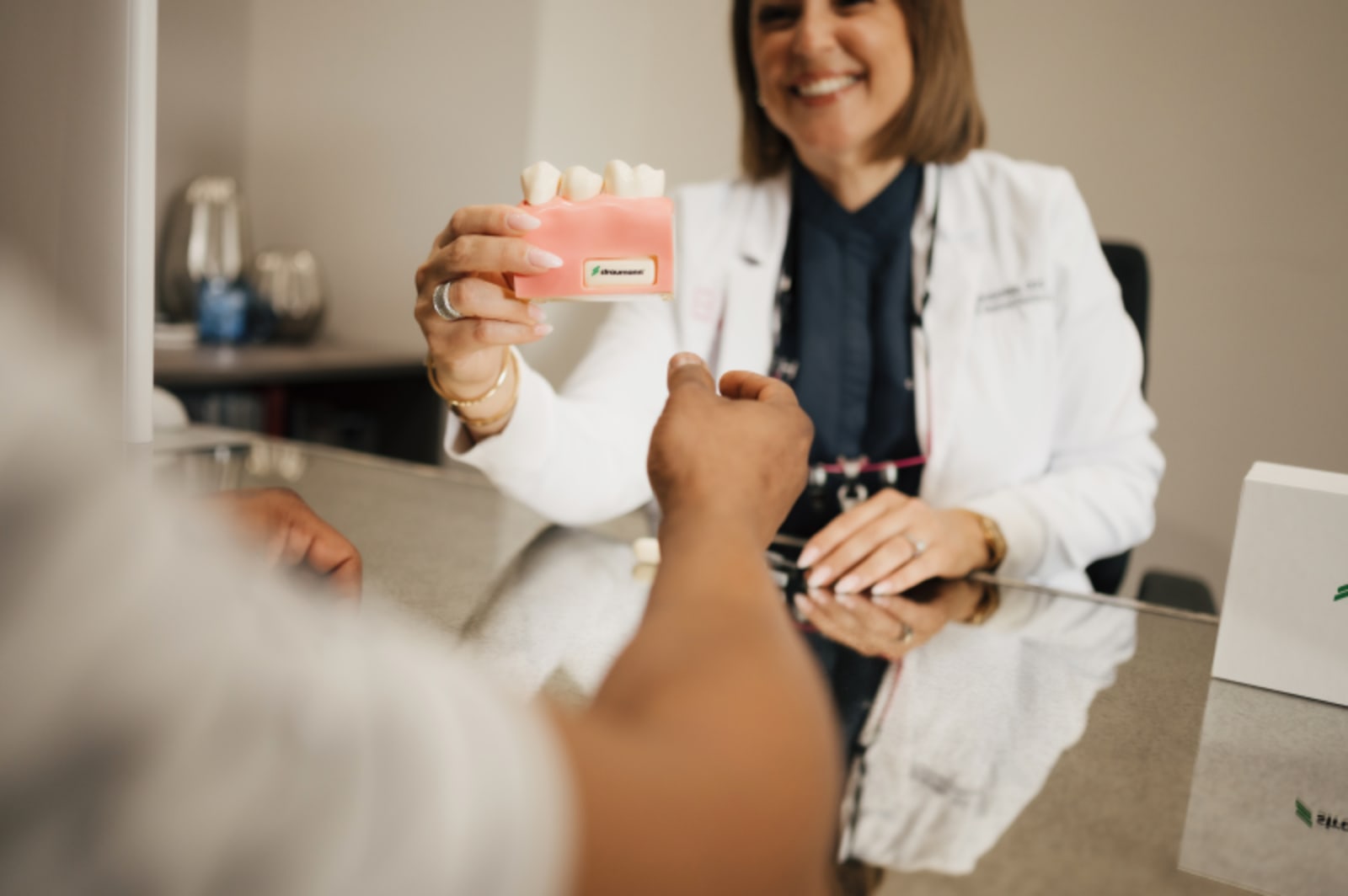
An implant isn't a single object. It's a precisely engineered system, placed in carefully sequenced stages by a clinician who understands how every component works together. What you end up with is a finished, fully functioning tooth that looks, feels, and performs like the real thing. Understanding the system helps you appreciate what each stage contributes:
- The implant post: a small titanium screw placed directly into the jawbone, replicating the function of a natural tooth root, anchoring the restoration and keeping the surrounding bone healthy and stimulated.
- The abutment: a precision connector that joins the post to the crown once osseointegration is complete, creating a stable, secure foundation for the final restoration.
- The crown: a custom-crafted porcelain restoration designed to match the shape, translucency, and shade of your natural teeth, indistinguishable to anyone who doesn't already know it's there.
- The surgical placement and planning: a carefully orchestrated process spanning imaging, precise placement, monitored healing, and final restoration, with each step guided by clinical judgment rather than a fixed schedule.
Much of what determines the outcome happens between appointments. After the post is placed, your bone gradually grows around it in a process called osseointegration, and that integration is what gives a well-placed implant its durability over decades. It takes time, and it takes a clinician who knows how to manage that process with precision. Dr. Taline oversees every stage personally, from the initial imaging through the final crown placement, so nothing is handed off and nothing is rushed. If bone loss is part of your history, our implant dentistry page outlines what that path can look like.
Sedation is available throughout the process for patients who want the experience to feel as unhurried as the care itself.
What Shapes Your Treatment Plan
Implant treatment is a custom plan built around your anatomy, your goals, and the result you want to achieve. These are the clinical variables that determine what your treatment involves:
- How many implants you need. Replacing a single tooth and restoring multiple teeth are different in scope. Each implant post is its own precisely placed surgical element, and the plan reflects that complexity.
- Where in the mouth. Back molars absorb far more chewing force than front teeth, and bone quality varies across the jaw. Location shapes both the surgical approach and the design of the final restoration.
- Bone density and volume. A strong, lasting implant requires solid bone. The quality and volume of your bone at the implant site directly informs how treatment is planned and sequenced.
- Whether extractions are needed. If a failing tooth needs to be removed before placement, that step is handled with the same care and precision as every other part of the process.
- Bone grafting or a sinus lift. When additional bone volume is needed, grafting rebuilds the foundation; a sinus lift addresses the upper back jaw specifically. These steps ensure the final result performs as it should, for as long as it should.
- The type of restoration. A single custom crown, an implant-supported bridge, and a full fixed arch like All-on-4 each involve different materials, lab craftsmanship, and clinical expertise. The restoration is designed specifically for you.
A complete picture only comes from a real clinical assessment. Bone requires imaging. Gums require an exam. And the right restoration requires a thorough conversation about your bite, your goals, and the outcome you're after, because no two cases are the same.
Bone Loss and Dental Implants: What It Means for Your Candidacy
When you lose a tooth, the jawbone underneath it starts to shrink. That's not a unique phenomenon; it's biology. Your bone stays dense because tooth roots stimulate it every time you bite and chew. Take the root away, and the body slowly reabsorbs the bone it's no longer using. The longer a tooth has been gone, the more loss there tends to be.
An implant post needs sufficient bone depth and width to anchor securely and perform the way it should for decades. If the bone has thinned, placing an implant without addressing that first compromises the result. Bone loss typically changes your plan, not your eligibility. Bone grafting is a well-established way to rebuild lost volume, either before placement or alongside it, and it's one of the implant dentistry services we handle in-house. Depending on your situation, it can shape:
- The timeline, since grafted bone often needs time to fully integrate before the implant is placed
- The sequencing of your treatment plan, which Dr. Taline will walk through with you in detail before anything is scheduled
Many patients who were told "no" elsewhere turn out to be excellent candidates once the right groundwork is laid. Dr. Taline reviews your actual imaging, asks the right questions, and builds a plan around what will produce the best long-term outcome.
Understanding Your Tooth Replacement Options
Implants are one option among several, and the right choice comes down to what you want your result to look like, feel like, and hold up like over time. Each approach involves real clinical tradeoffs: how it interacts with your bone, how it performs over the years, and what it asks of you along the way.
Traditional bridges
A bridge replaces the visible tooth but not the root beneath it. To place one, the healthy teeth on either side of the gap must be filed down permanently to serve as anchors, a structural compromise that affects teeth that were otherwise intact. The bridge itself will typically need to be replaced over time, and because nothing is stimulating the bone beneath the gap, the jaw continues to change underneath it. In certain clinical situations it may be appropriate, but it addresses the gap without addressing what lies beneath it.
Dentures
Dentures sit on the surface of the gum rather than integrating with the jaw. Over time, as the bone beneath them continues to resorb, the fit changes, requiring periodic relines and eventual replacement. They do not preserve bone, and the experience of wearing them is meaningfully different from having a tooth anchored in the jaw.
All-on-4 and full-arch implants
For patients missing most or all of their teeth in a jaw, an All-on-4 restoration anchors a full fixed arch on as few as four implants, delivering stability, function, and a natural appearance in a single, well-engineered solution. Because the implants integrate with the bone, they preserve jaw structure in a way that surface-resting options cannot.
Single and multiple implants
An implant replaces the entire tooth, root and crown alike. The titanium post integrates with your jawbone, preserving its density and structure the way a natural root would. The result looks, functions, and feels like a real tooth, and with proper care, a well-placed implant can last for decades.
Who Is a Strong Candidate for Dental Implants
Great implant outcomes are built on a solid clinical foundation. Here's what Dr. Taline looks for when building a treatment plan:
- Adequate bone, or a clear plan to restore it: bone grafting is a well-established part of implant care, and bone loss rarely closes the door
- Healthy gum tissue, since active periodontal disease is addressed before placement to ensure the implant has the healthiest possible environment to integrate
- Good general health, because the body's healing response is what allows the implant to fuse fully and function beautifully for decades
- Consistent home care, meaning the kind of daily attention and professional maintenance that keeps a finished result looking and performing its best long-term
- An appreciation for the process, which unfolds over several months, because precision and permanence are never rushed
Certain factors make the planning more nuanced. Smoking, uncontrolled diabetes, specific medications, and a history of grinding are all worth discussing openly; they inform the approach but are rarely reasons to rule implants out entirely. Age is almost never a limiting factor either. Dr. Taline has placed implants for patients well into their 60s, 70s, and beyond, holding every case to exactly the same standard of care.
What to Expect: The Implant Timeline, Surgery, and Recovery
A well-placed implant unfolds in carefully sequenced stages, each one building the foundation for a result that looks, feels, and functions like a natural tooth. The process takes time by design, and every step serves a purpose.
Here's how it typically unfolds:
- Initial consultation and imaging. Before anything is placed, Dr. Taline takes a complete three-dimensional picture of your jaw using cone beam CT imaging. That level of detail goes far beyond a standard X-ray, and it's what allows for precise, personalized placement planning. Every case is mapped individually.
- Preparatory work, if needed. If extractions, bone grafting, or other preparatory steps are part of your plan, they happen first, sequenced carefully to ensure the final result holds up exactly as it should over time.
- Implant placement. The titanium post is placed directly into the jawbone in a surgical appointment. Sedation options are available to keep the experience calm and comfortable from start to finish.
- Osseointegration. Over the course of several months, the bone grows around and fuses with the implant post. This biological integration is what gives a well-placed implant its durability, and it cannot be shortened without compromising the outcome.
- Abutment and crown placement. Once integration is confirmed, the abutment is attached and the final crown is placed. The crown is custom-crafted to match your surrounding teeth in shape, shade, and proportion, finished to be indistinguishable from a natural tooth.
From first appointment to final restoration, the full timeline typically spans several months, sometimes longer depending on your case. Each stage is given the time it requires.
Comfort and Sedation During Your Implant Treatment
Dr. Taline's own experience with a gentle, attentive dentist is what drew her to the profession, and it shapes how she approaches every appointment. The clinical work matters deeply, and so does how you feel throughout it.
Sedation options are available for patients who want to move through the procedure in a state of complete ease, and we take the time to understand your preferences before recommending anything. Every appointment is unhurried by design. Dr. Taline explains each step before it happens, answers every question fully, and never moves faster than you're comfortable with.
Planning Your Investment: Insurance, Medical Coverage, and Payment
Traditional dental insurance was built around preventive and basic restorative care, so implants often fall outside what those plans were designed to cover. Some policies contribute toward the crown or preparatory steps like extractions, and a quick call to your carrier will clarify what applies to your specific plan.
If your tooth loss is connected to an accident, injury, or documented medical condition, your health insurance may have a role to play as well. It's worth exploring with both your insurer and your dental team before your consultation.
As a fee-for-service practice, TÜTH Dental builds every treatment plan around what's clinically right for you, your goals, and your long-term outcome. That independence is what allows Dr. Taline to recommend what genuinely serves your health rather than what a coverage structure happens to allow.
How to Choose an Implant Provider in Katy

The quality of your outcome depends almost entirely on the clinical judgment, continuity of care, and attentiveness of the provider you choose. A handful of direct questions reveal a great deal before you ever commit to a treatment plan.
- Does this provider place implants themselves, or refer the surgery out? A practice that handles placement and restoration in-house gives you continuity and a single point of accountability throughout. Dr. Taline oversees every stage of your implant care from first imaging to final crown.
- Will you receive a complete, personalized treatment plan before anything is scheduled? How a provider approaches the planning conversation tells you a great deal about how they approach the work itself.
- What imaging do they use to plan placement? Cone beam CT imaging provides the three-dimensional detail that precise, confident placement requires. Flat X-rays alone are not sufficient for complex cases.
- What is the depth of their implant experience? Volume and marketing recognition are not the same as clinical depth. Dr. Taline's continuing education in implant and cosmetic dentistry is reflected in every treatment plan she builds.
A provider who listens carefully, explains each decision clearly, and never moves faster than you're ready for is demonstrating something credentials alone cannot convey.
What a Dental Implant Consultation Looks Like and How to Prepare
A consultation with Dr. Taline is where the real work begins. This isn't a quick scan-and-quote. It's a thorough, unhurried conversation built around understanding your anatomy, your goals, and what a truly excellent result looks like for you specifically. Here's what that process involves.
It starts with advanced imaging. A cone beam CT scan gives Dr. Taline a full three-dimensional view of your jaw structure, providing the kind of detail that makes precise, confident treatment planning possible. This is where the clinical picture comes into focus: bone quality, available volume, and the exact conditions that will shape your treatment. From there, the assessment looks at:
- The density and volume of bone at the implant site
- The condition of nearby teeth and gum tissue
- Your overall oral health and anything that could affect the quality of your outcome
- Your medical history, including medications and conditions relevant to implant success
Once that picture is complete, Dr. Taline will walk you through a fully personalized treatment plan. Every step, every detail, every decision is explained clearly before anything is scheduled.
A little preparation makes the conversation richer. Bring a list of your current medications, your medical history, any recent X-rays, and whatever questions are on your mind about the process, the timeline, and what to expect at each stage.
Ready to See What's Possible for Your Smile?
A well-placed implant is the product of precise planning, careful sequencing, and a clinician who takes the time to get every detail right. What comes next is understanding what that looks like for your specific anatomy, your goals, and the result you have in mind.
Dr. Taline will review your imaging, walk through every aspect of your treatment in plain language, and answer every question fully before anything is scheduled. If bone loss is part of your history, that's part of the conversation. Every plan is built from scratch around the individual sitting in the chair.
We're located in Katy at 2020 S Fry Rd, Suite I, and see patients from across the greater Houston area, Monday through Friday.
To schedule a consultation, call (281) 717-4928.
Connect
We look forward to welcoming you.
Contact us today at 281-717-4928 to schedule an appointment.