

Everything You Need to Know About Dental Veneers in Katy, TX
At TUTH Dental, we believe everyone deserves a confident, beautiful smile—and clear aligners can help you achieve just that. Our modern, discreet alternative to traditional braces is designed to straighten your teeth comfortably and without interrupting your lifestyle. Serving the Katy, TX community, our skilled dental team is here to guide you through every step of your smile transformation with personalized care and cutting-edge technology.


If you've been studying your smile and wondering whether veneers are the answer, this guide is a good place to start. Veneers are thin, custom-made shells bonded to the front of your teeth, and they address color, shape, length, and spacing all at once.
They're a cosmetic treatment, not a structural repair, and the quality of the result comes down almost entirely to the skill and artistry of the person designing and placing them.
Dr. Taline put this guide together for patients who are genuinely weighing this decision and want a clear, honest picture before they commit to anything. She'll walk you through the materials, the appointments, and the trade-offs, and if whitening or bonding would serve you just as well, she'll tell you that too.
When you're ready to talk through your specific situation, we'd love to hear from you. Call TÜTH Dental at (281) 717-4928.
What to know first
- Veneers address stains, chips, gaps, worn edges, and small or misshapen teeth in a single treatment. Whitening alone can only address staining.
- Porcelain and composite are the two real choices. Porcelain resists stains and lasts longer. Composite is sculpted in the chair and refreshed more often.
- A typical porcelain veneer case unfolds across a few visits: consultation, gentle preparation, impressions, temporaries, then bonding the final set.
- Because veneers are a cosmetic treatment, dental insurance typically doesn't apply. Dr. Taline walks through every detail of your case during your complimentary consultation, so you know exactly what your plan involves before anything is scheduled.
- The material is standardized. The artistry is not. Who designs and places your veneers is the single biggest variable in how natural your smile looks for years to come.
What veneers actually are, and what they aren't
A veneer is an ultra-thin shell of porcelain or composite resin bonded to the visible front surface of a tooth. Each one is shaped and shaded individually so it sits in your smile line without announcing itself. A well-made veneer feels like enamel, because that's exactly what it's designed to imitate.
Veneers are a cosmetic treatment, not a structural one. They don't make a weak tooth strong. When a tooth needs protection, a crown wraps around the whole thing. A veneer covers only the visible front surface and leaves the rest of the tooth untouched.
It's a precise, targeted change, which is part of what makes the result so natural when the work is done well.
There are specific concerns veneers address beautifully:
- Deep, set-in stains that professional whitening can't lift, including tetracycline-type discoloration.
- Chips, small cracks, and worn or jagged edges.
- Gaps and uneven spacing between front teeth.
- Older fillings on front teeth that have taken on permanent staining.
- Teeth that are too small, too short, or out of proportion with the ones beside them.
Where veneers aren't the right tool is significant crowding or bite problems. Porcelain covers teeth; it doesn't move them. Placing veneers over an unstable bite tends to shorten how long they last. If your teeth need repositioning first, Invisalign is often the right starting point, sometimes as the only treatment needed, and sometimes as the foundation before veneers complete the picture.
The types of veneers, and how they differ
Material shapes everything: how the finished smile looks, how long it holds up, and what the appointments involve. Three options are worth understanding.
Porcelain veneers
Porcelain is the standard for a reason. It's glassy in a way composite isn't, so it handles light the way natural enamel does, picking up translucency at the edge and warmth near the gumline rather than reading as a flat white slab. It also resists staining, which matters if coffee or red wine are part of your day. Porcelain veneers are crafted in a dental lab from impressions of your prepared teeth, with temporaries in place while you wait. With good care, they commonly last 10 to 15 years or longer.
Composite veneers
Composite resin is sculpted directly onto your teeth, usually in a single visit. Dr. Taline shapes and polishes the material by hand, which makes this a genuinely artistic chairside procedure. Composite blends beautifully with enamel and can be refined or added to over time. It does stain more readily than porcelain and typically needs refreshing around the five to seven year mark, so it suits patients who prefer flexibility over permanence.
No-prep veneers
These are lab-made but thin enough that little to no enamel needs to be removed, so placement is quicker and often requires no numbing. They work well when teeth are already well positioned and the goal is to add rather than mask. If a tooth is dark or protruding, placing thin porcelain on top only amplifies the problem. Whether your teeth are good candidates is something Dr. Taline can assess during a complimentary consultation at our Katy office.
You may also come across pop-on veneers while researching. They are removable plastic trays, not a dental treatment, and they are not something we offer or recommend.
What getting veneers actually looks like
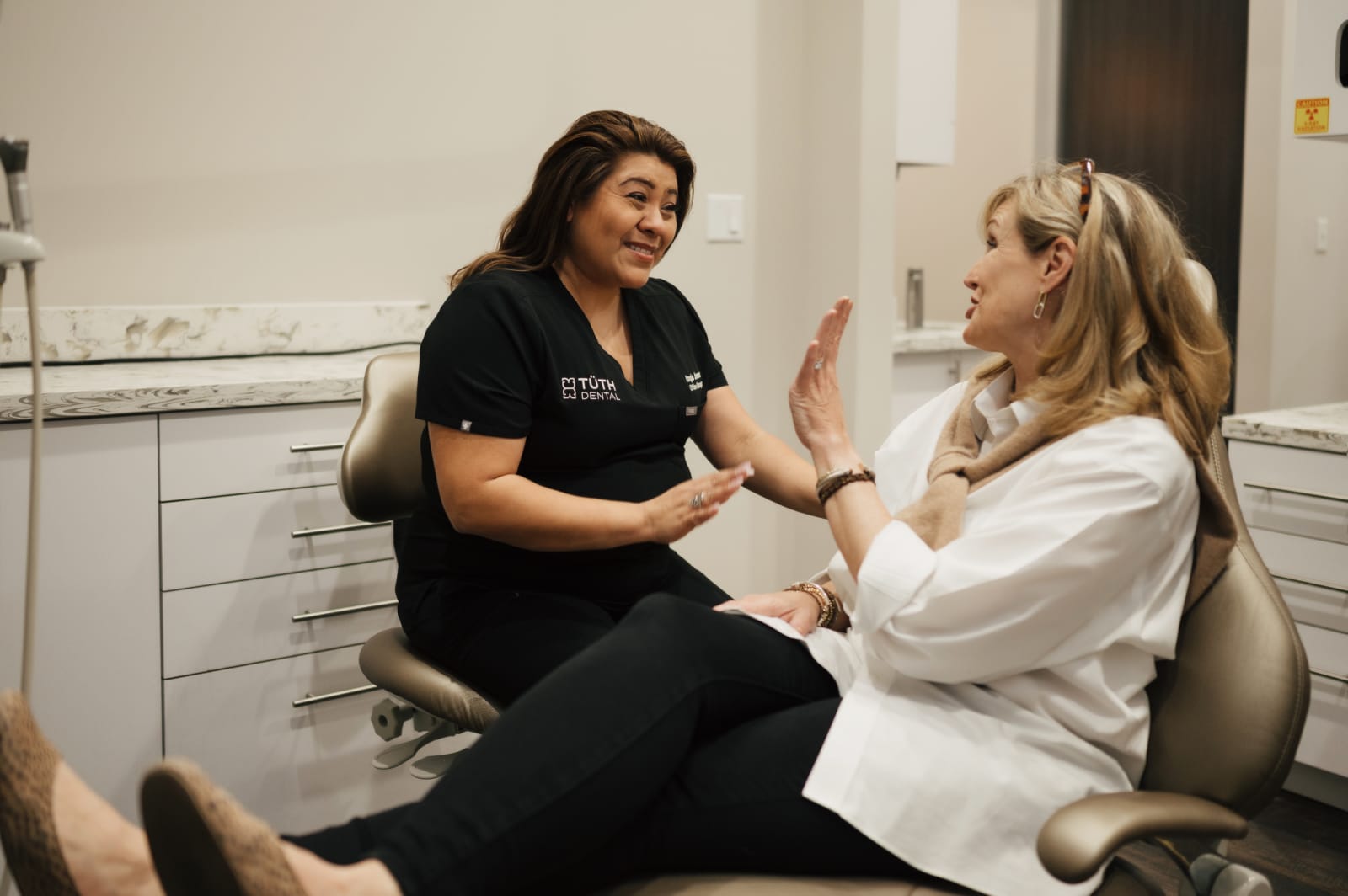
A porcelain veneer case unfolds across several appointments over a few weeks. Nothing is rushed, and every step is designed to give you time to see, feel, and approve the result before it's final. Here's how it goes.
1. Consultation and smile design
Dr. Taline starts by looking at your teeth, gums, and bite, and by asking what specifically bothers you when you see yourself. "I want whiter teeth" and "I hate how short my front teeth look" lead to very different plans, and she listens carefully before recommending anything. She'll tell you honestly whether porcelain veneers are the right approach, how many teeth would need treating for a balanced result, and what the timeline looks like. Your consultation is complimentary.
2. Preparing the teeth
To allow the porcelain to sit flush and natural-looking, a very thin layer of enamel is gently removed from the front of each tooth, typically around half a millimeter. The area is numbed first. Because this step is permanent, Dr. Taline takes care to make sure you understand exactly what's involved and feel confident before anything begins.
3. Impressions and shade selection
Impressions of the prepared teeth are taken, along with detailed notes on shade, translucency, and shape, so the ceramist has a complete picture to work from, not just a number. Shade is chosen with your skin tone, eyes, and surrounding teeth in mind. If you're planning professional teeth whitening on your natural teeth, that happens before shade selection, since porcelain won't respond to whitening gel later.
4. Temporaries
Acrylic temporaries protect your prepared teeth while the lab works, and they give you a real preview of the result. You'll have a couple of weeks to live with the length and shape, to talk, eat, and see yourself in photos. If something feels too long or too square, you tell us and those notes go directly to the lab before anything is finalized.
5. Lab fabrication
A skilled ceramist builds your veneers by hand, layering porcelain to create depth and translucency rather than a single flat shade. This takes about two to four weeks. That time is where the artistry happens, and it's exactly what separates a result that looks genuinely natural from one that doesn't.
6. Placement
Dr. Taline places the veneers for a full preview before anything is bonded permanently, checking fit, shape, color, and how they look together when you smile and speak. Only once you're happy are they bonded with dental adhesive and the bite refined until everything feels natural.
7. Follow-up and living with them
A follow-up visit a couple of weeks later confirms the gums have settled and gives us a chance to make any small refinements. After that, veneers ask very little of you: brush, floss around the margins, keep your routine checkups and cleanings, and avoid using your front teeth to open packaging or crunch ice. If you grind at night, a nightguard is built into your treatment plan from the start.
What the investment reflects
Veneers are a cosmetic treatment, so dental insurance typically doesn't apply. What your case involves depends on how many teeth are being treated, the material, and the depth of the design work. Dr. Taline walks through all of it during your complimentary consultation, before anything is scheduled.
What you're investing in isn't the porcelain itself. It's the time and attention that produce a result worth having: the careful diagnostic work up front, the preparation done without shortcuts, the ceramist's hours building depth into each shell, the try-in appointment where fit and shade are refined rather than simply accepted. Cosmetic work done at volume compresses exactly those steps, which is why two sets of porcelain veneers made from the same material can look nothing alike. If a different approach would serve you better, whether that's whitening or something else entirely, Dr. Taline will tell you so.
What to weigh before you commit
Veneers are safe and beautifully predictable in the right case. Part of what makes a consultation with Dr. Taline worthwhile is that she'll walk you through these trade-offs honestly, so you go in with clear eyes:
- Enamel removal is permanent. Once a tooth is prepared, it will need a veneer or crown on it from then on. This is a long-term commitment, which is exactly why the consultation and design conversation matter so much.
- Some sensitivity is normal early on. It typically settles within a few weeks as your teeth adjust.
- Porcelain can chip or debond. A damaged veneer is replaced, not patched. Heavy grinding is the most common culprit, and it's something we plan around from the start.
- Your natural tooth can still decay. The veneer covers the front surface. The margins and the rest of the tooth still need careful brushing, flossing, and your regular checkups and cleanings.
- Gums change over decades. Over many years, the margin line can become visible as gums naturally recede. It's one reason veneers are eventually refreshed rather than lasting forever.
If you grind, have an unstable bite, have active gum concerns, or are imagining a result the underlying teeth can't support, Dr. Taline will tell you plainly. And if whitening or Invisalign would serve you better than porcelain, that's exactly what she'll recommend. The goal is a result you'll love for years, not a treatment done for its own sake.
How to tell good cosmetic work from the rest

Whether you love your smile five years from now comes down almost entirely to who designed and placed it, not which material they used. These are the things worth looking for:
- Their own before-and-after photos, in volume. Not stock images, not one flattering case. Look for variety in age, tooth shape, and starting condition, and pay as much attention to the gumline as you do to the teeth.
- Individuality in the results. If every patient in the gallery has the same eight identical white rectangles, that is a template, not a design. Natural teeth are not all the same length, and central incisors should be slightly longer than the laterals.
- Unhurried time with you. A dentist who asks what specifically bothers you, listens carefully, and lets you live with the temporaries before anything is finalized is doing genuinely custom work.
- Willingness to talk you out of it. A cosmetic dentist who tells you whitening might be enough, or that straightening with Invisalign first would serve you better, is giving you the most useful information in the room.
- Real credentials, not volume badges. Ask about continuing education in cosmetic dentistry and ask to see cases that resemble yours. A high sales ranking from an aligner company is not the same thing as clinical skill.
Dr. Taline earned her Doctorate in Dental Surgery with honors from the USC School of Dentistry, following a Bachelor of Science in Human Anatomy at UCLA. She has devoted years of continuing education to cosmetic, implant, and pediatric dentistry, and she is an active member of the American Dental Association, Texas Dental Association, and Greater Houston Dental Society.
A difficult childhood dental appointment left her afraid of the dentist for years. A later one, with a USC-trained dentist who took his time and actually listened, changed everything. That experience is what she brings to every patient she sees in Katy.
Questions we hear most
Do veneers damage your natural teeth?
Not in the way most people fear. No-prep veneers remove little to nothing, so if your teeth are already well positioned, that option may be on the table. Traditional veneers do remove a thin layer of enamel, which commits you to keeping a veneer or crown on that tooth going forward. That's a conversation worth having before anything is decided, and Dr. Taline will walk through exactly what your case would involve.
How many teeth actually need to be treated?
It depends on how far your smile shows when you talk and laugh. Some people need only the two front teeth; more often it's the six or eight teeth visible in a full smile, because matching two new veneers to six untouched teeth is harder than designing them as a set. During your complimentary consultation, Dr. Taline will show you exactly where the natural break point is for your smile.
Will people be able to tell they're veneers?
With well-crafted porcelain veneers, no. Porcelain has depth and translucency, so it catches light the way enamel does rather than reading as a flat white surface. Veneer work that gives itself away usually does so through proportion and shade: teeth that are too uniform, too long, or too bright for the person's face. You'll see your own proportions in temporaries before anything is finalized, so there's no guessing involved.
What if I grind my teeth?
Grinding doesn't rule out veneers, but it does shape the plan. We address it first, then design around it, and a nightguard is built into your treatment from the beginning so your results are protected.
Can I whiten my veneers later if I want them brighter?
Porcelain and composite don't respond to whitening gel, so the shade you choose at the start is the shade you keep. That's why we take shade selection seriously, and why some patients choose professional teeth whitening for their natural teeth before veneers are made, so everything matches from day one.
Come see whether veneers fit your smile

If you've been sitting with questions about your smile, this is a good place to bring them. At your complimentary consultation at our Katy office on S Fry Rd, Dr. Taline will take the time to really look at your teeth, hear what you want changed, and give you an honest picture of whether veneers, whitening, Invisalign, or a combination of approaches is the right path for you.
Nothing is rushed, and nothing is decided until you feel ready.
Call Dr. Taline's team at (281) 717-4928 and let's start with a conversation.
Connect
We look forward to welcoming you.
Contact us today at 281-717-4928 to schedule an appointment.